
Request for Proposals: Research & Evaluation (R&E) Communications Consultant
Remote (Westlake Village, CA)
Conrad N. Hilton Foundation
Date Posted: 5/29/2026
Purpose
The Foundation’s initiatives have invested significantly in research and evaluation (R&E) during S25. SLED and the Communications department aligned on the need for a systematic approach to communicating cross-learning—externally to the field and partners and internally across initiatives—including a thematic approach, a phased pilot structure, and clarified roles and processes.
Objectives
Deliver a clear, audience-differentiated SLED R&E communications strategy, including goals, audiences, positioning, thematic focus, and channel approach.
Define 4–5 cross-cutting themes for SLED to disseminate over the next 12–18 months. Design an implementable operating model with intake-to-publication workflow, governance and approvals, roles and responsibilities, and decision rules for communication.
Provide practical tools, such as templates, briefs, and tagging taxonomy guidance, to enable consistent execution and reduce workload for SLED and Communications teams.
Establish a 2026 pilot operating approach with 2–3 themes to validate the workflow and refine for scaling beginning in 2027.
Scope of Work
A. Discovery and Alignment
Review existing materials (e.g., R&E tracker structure, representative R&E products, current learning site structure) and synthesize implications for communications.
Conduct stakeholder interviews / working discussions with SLED, the Communications department, and initiatives to confirm intent, constraints, and decision-makers.
Facilitate a working session to answer key design questions (priority audiences, desired audience actions, criteria for what merits external comms, and how internal learning comms fits).
Document agreed upon assumptions, open questions, and decisions needed to proceed.
B. Strategy Development
SLED
Develop an audience map (primary/secondary audiences) and articulate intended audience actions (e.g., adopt a practice, share evidence, inform policy, apply learning).
Define SLED’s R&E communications positioning and narrative frame (what SLED will be known for in evidence/learning dissemination).
Identify and describe 4–5 cross-cutting themes and how each theme will be communicated (core message, proof points, audiences, best-fit channels).
Recommend a structure and internal process for a Comms Resource Hub that houses qualitative and quantitative assets—such as statistics, quotes, case studies, and key findings—to support efficient storytelling.
Communications Department
Recommend channels, digital platforms, media, events, and content formats by audience and objective (with lightweight guidance on cadence and sequencing).
Translate strategy into a brief “playbook” that staff can use without ongoing consultant support.
C. Workflow, Governance, and Decision Rules
Develop a thematic pipeline management approach that enables SLED to plan, prioritize, and manage communications across related bodies of work.
Define intake expectations and lead times (e.g., when and how Learning and Evaluation Officers (LEOs) flag upcoming reports; target lead time such as ~60 days prior to expected report receipt).
Create decision rules to triage products into comms pathways (e.g., full brief vs short summary vs internal-only vs no comms), including minimum quality/utility thresholds.
Propose a governance and approvals model (who reviews what, in what order, and turnaround time targets), including cross-initiative coordination where needed.
Define a recurring cadence for planning and prioritization (e.g., monthly pipeline review) and how decisions will be made.
D. Tools, Templates, and Infrastructure Alignment
Provide recommendations for a learning site structure that supports thematic navigation and timely publication (not purely archival), including where SLED/Initiative “point of view” content lives.
Develop a toolkit of templates: Create practical tools—such as content briefs and “so what” synthesis outlines and publication priority checklist. Products to be developed using existing Airtable and other existing Foundation tools.
Provide recommended taxonomy and tagging guidance: Establish a system for categorizing and tagging R&E products by theme, including CNHF strategic communications framework, which helps organize the tracker and supports the communications pipeline.
Implement initial taxonomy coding of existing R&E resources
Define minimum metadata standards for each R&E product to enable triage and reuse (e.g., topic/theme tags, audience, sector, key takeaways, limitations, publishability).
Identify core metrics for tracking progress toward goal of increased access to and dissemination of research and evaluation products.
E. Pilot Operating Model (Lightweight)
Support selection of 2–3 pilot themes for 2026 based on what is already available and what is in the pipeline.
Develop a lightweight editorial approach (key messages, priority audiences, recommended outputs by type, and a realistic cadence) for each pilot theme.
Run the workflow end-to-end to validate decision rules, timing, and approvals (focus is on process proofing for 1 fully implemented pilot theme).
Facilitate a retrospective with SLED and the Communications department and refine the strategy playbook and workflow artifacts for scale.
Deliverables
Discovery readout: stakeholder synthesis, key decisions, and constraints. SLED R&E communications strategy deck or memo: audiences, objectives, positioning/narrative, thematic framework (4–5 themes), and channel/format recommendations.
Theme one-pagers (4–5): for each theme—core message, target audiences, proof points, example assets, and recommended distribution approach.
Operating model package: workflow map, governance/approvals model, decision rules, and meeting cadence.
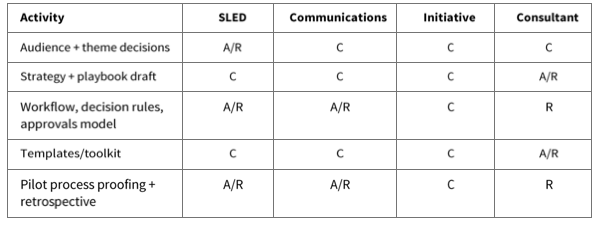
RACI and ways-of-working: roles across SLED, the Communications department, and Initiative teams; handoffs and turnaround targets.
Templates/toolkit: intake form, content brief template, “so what” synthesis outline,
review checklist, and post-publication tracking fields.
Socialization sessions: facilitation of 3 interactive sessions to familiarize program department staff, including Initiatives, with relevant workflows (e.g., research production to publication) and templates (e.g., intake form, “so what” synthesis outline)
Implementation support + closeout package: facilitation/coaching during early adoption (e.g., pipeline meetings and theme/editorial working sessions), light-touch refinements to workflow artifacts/templates based on early use, and a final retrospective + closeout readout (presentation and short memo with recommendations for scaling in 2027).
Success Measures
Success will be measured by completion of strategy outputs and evidence of adoption of the workflow and tools during the pilot period.
Strategy completed and usable: Strategy memo/deck and theme one-pagers delivered, reviewed, and approved by SLED and the Communications department by the agreed milestone date.
Clear decision rules adopted: Intake criteria and triage pathways documented and used in at least one live pipeline review.
Workflow adoption: Standing cadence established (e.g., monthly pipeline review) with documented decisions, owners, and next steps for at least 3 consecutive cycles during the implementation support period (September–November 2026).
Cycle-time improvements: Agree on clear time targets for each step (e.g., how many days it should take to go from first draft to final approval) and meet those targets for pilot items during the proof-of-concept period.
Pipeline health: A defined share of upcoming R&E products is flagged in advance (per agreed lead time), tagged to themes, and have minimum metadata fields completed.
Pilot validates operating model: 2–3 pilot themes run through the workflow with a retrospective that results in concrete process/tool refinements.
Stakeholder satisfaction: SLED and the Communications department report that the strategy and tools reduce ambiguity and effort, and enable consistent publishing decisions.
Out of Scope (Unless Separately Contracted)
High-volume content production (e.g., ongoing drafting of briefs, op-eds, web pages, or social copy). Note: The scope does include early implementation support (facilitation/coaching and refinement of workflow artifacts/templates), but not ongoing production work.
Graphic design, web development, or publishing support (beyond recommendations and workflow alignment).
Media relations, public relations (PR) pitching, or spokesperson training.
Comprehensive analytics implementation (beyond defining recommended success measures and what to track).
Timeline (July 2026–January 2027)
July 2026 (Discovery + decisions): Review existing materials; conduct stakeholder interviews; facilitate working session(s); confirm priority audiences, intended audience actions, decision-makers, constraints, and initial governance assumptions; deliver discovery readout.
August 2026 (Strategy + themes, draft): Develop audience map and positioning/narrative frame; draft 4–5 cross-cutting themes and initial theme one-pagers; draft channel/format recommendations and strategy playbook (one-page).
September 2026 (Operating model + toolkit, finalize): Map intake-to-publication workflow; finalize governance/approvals model, decision rules, cadence, and ways-of-working; produce workflow artifacts (RACI/SLAs) and templates/toolkit; confirm minimum metadata standards and tracker tagging guidance; provide learning site structure recommendations.
October–December 2026 (Early implementation support): Support initial adoption of the operating model by facilitating up to 3 pipeline review sessions and up to 3 theme/editorial working sessions; coach SLED and the Communications department on applying decision rules, lead times, and templates; provide light-touch troubleshooting and refinements to workflow artifacts/templates based on early use (focus remains on implementation support rather than high-volume content production).
January 2027 (Final review + closeout): Facilitate a final retrospective; deliver a short implementation learning memo (what worked, what needs adjustment, and recommendations for scaling in 2027); present final strategy + operating model package; complete handoff and closeout.
Roles and Collaboration
SLED: Provide access to the R&E tracker and products; supply subject-matter input and the “so what” implications; identify candidate themes and priority audiences; serve as day-to-day owners of the pipeline once established.
Communications department: Advise on channel strategy and packaging; align learning site recommendations with broader communications infrastructure and standards; partner on governance/approvals.
Initiative staff: Supply subject matter input and the “so what” implications, support identification of relevant partners whose work or data can feed into the communications pipeline.
Consultant: Lead discovery/facilitation; draft strategy and thematic framework; design workflow/governance and templates; drive completion of deliverables; support lightweight pilot and handoff.
Consultant Qualifications
Demonstrated experience developing communications strategies and operating models (workflow/governance/templates) for complex organizations.
Strong facilitation skills and ability to drive alignment across multiple stakeholder groups. Ability to translate research/evaluation into clear, audience-appropriate narratives (for purposes of strategy and framing).
Experience with knowledge management / learning dissemination approaches (e.g., thematic organization of learning products) preferred.
Familiarity with philanthropy, evidence dissemination, and/or social sector learning contexts preferred.
Remote with expectation of occasional in-person (Westlake Village, CA) meetings/facilitation of sensitization sessions, as needed to facilitate project success
Proposal Requirements
Statement of understanding and proposed approach (with emphasis on strategy + workflow/governance design).
Proposed workplan and timeline aligned to the phases above, including key milestones and review points.
Proposed deliverables list (confirming format: deck/memo, templates, workflow map, etc.).
Team/staffing and roles
2–3 relevant examples of prior work (strategy, operating model/workflows, playbooks/toolkits; research translation examples optional).
Pricing (fixed fee preferred, or hourly with a total contract value not-to-exceed $80,000) and assumptions.
Send materials above to Eundria Hill-Joseph, Learning and Evaluation Officer at eundria.h@hiltonfoundation.org. Subject Line: R&E Comms_[Last Name].
Materials will be accepted and reviewed on a rolling basis between May 28- June 10, 2026 with a decision made by June 19th.